Vape airflow: how to set your draw properly

A draw that suffocates, another that pulls on nothing, vapour that arrives too hot, or a gurgle followed by a drop of liquid on the tongue. More often than not the culprit is a single neglected setting. The vape airflow ring, fitted to almost every tank and most pods, decides the comfort of every single puff, and a great many people never touch it or twist it at random.
Vape airflow: what the ring actually does
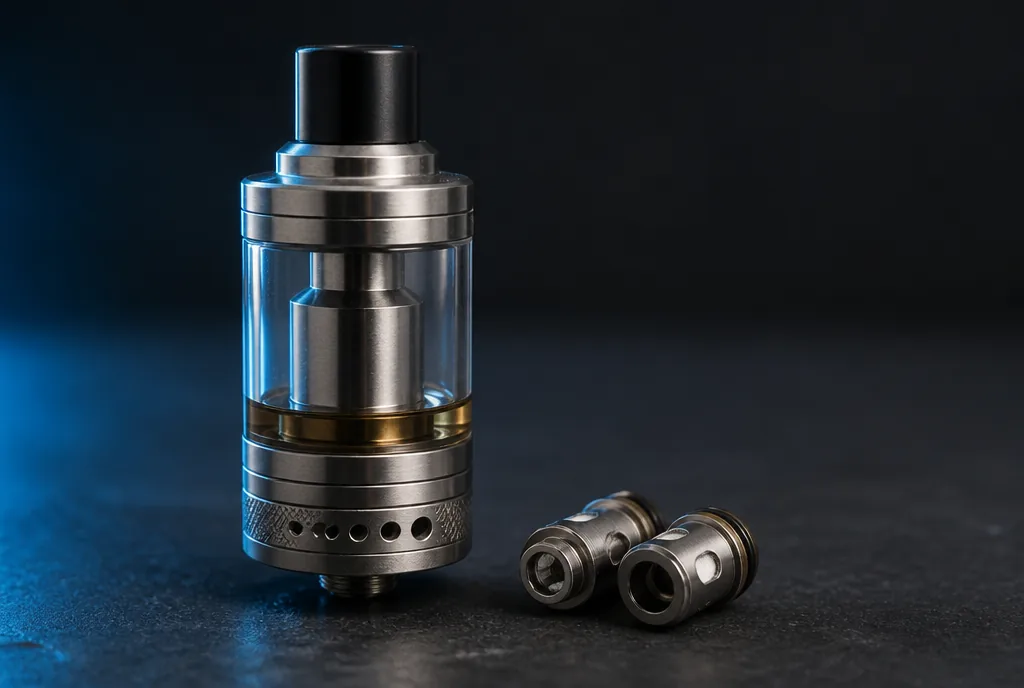
Setting the vape airflow means metering the air that enters while you draw. The ring sits at the base or the top of the tank, and turning it opens or closes the inlet slots underneath.
Closed down, it gives a tight draw, warmer vapour and a more defined throat hit. Opened up, it gives an airy draw, cooler and more abundant vapour and a softer hit. Nothing else on the device changes.
There is no universal correct position. The right one depends on the style you are aiming for, on the coil fitted and on the liquid in the tank, which is why a setting copied from someone else rarely feels right on your own kit.
Finding the right setting for your style
Airflow is never adjusted in the abstract. It is adjusted against the sensation you want, and each style of inhaling asks for a different position on the same ring.
For a tight draw, the ring closes down until the pull recovers the resistance of a two stage inhale. Air enters through a narrow slot, vapour concentrates and the throat hit sharpens. This is the position that matches coils above 1 ohm, and our MTL vaping guide sets out the coils and settings that go with it.
For a fully open direct draw, the ring opens wide to admit a large volume of air. Vapour cools, expands and the pull becomes effortless. This accompanies low resistance coils and higher wattage, and the right opening is found in small increments rather than in one movement.
Between the two sits the restricted direct position, written RDL or RDTL across British listings. The gesture stays single stage while the inlet stays narrowed, and our guide to RDL vaping explains what that register delivers.
Why vape airflow matters more in the UK
There is a reason this ring deserves more attention here than it gets elsewhere, and it comes down to what British rules leave adjustable.
Refillable tanks and pods are capped at 2 ml. Nicotine containing e-liquid is capped at 20 mg per ml and sold in bottles of no more than 10 ml. Those numbers are fixed for everyone, whatever kit you buy and whatever style you vape.
So the levers that remain genuinely yours are the coil, the wattage and the vape airflow. Of the three, the airflow ring is the only one that costs nothing, takes a second and can be reversed immediately if you dislike the result.
It also explains a habit peculiar to this market. Because a 2 ml tank empties fast on an open draw, many British vapers run their airflow deliberately tighter than the hardware allows, trading some volume for a tank that lasts the morning. The ring is being used as a consumption control as much as a comfort control, which is a perfectly sensible thing to do with it.
Fixing the common draw problems
A badly set inlet causes a long list of complaints that get blamed on faulty hardware. The table below matches the symptom to the correction.
| Symptom | Likely cause | What to do |
|---|---|---|
| Draw too tight, you have to force it | Inlet closed too far, coil clogged | Open the ring, inspect the coil |
| Draw too open, pulling on nothing | Inlet too wide for the style | Close the ring partway |
| Gurgling, liquid reaching the mouth | Inlet too open, liquid too thin | Close it slightly, review the base |
| Vapour too hot | Inlet too closed, wattage too high | Open the ring, lower the power |
| Whistling on the draw | Slots partly blocked | Clean the inlets |
| 2 ml tank emptying by lunchtime | Inlet wide open on a low resistance coil | Close it a notch, or change coil |
The pattern is clear enough. Before suspecting a fault, setting the vape airflow correctly resolves a large share of everyday discomfort. A coil at the end of its life or a liquid that does not suit the build can still keep the problem alive despite a good setting.
The mistakes to avoid with vape airflow
A few clumsy habits spoil the adjustment, and knowing them saves a lot of trial and error.
The first is going fully open or fully closed in one movement, which makes it impossible to feel where the good position was. Move one notch at a time and take a slow draw after each change.
The second is forgetting that the inlet works alongside the coil and the wattage. Opening a small, high resistance coil wide gives a lukewarm, washed out result, because the air dilutes vapour that was never abundant to begin with. Conversely, closing a low resistance coil right down traps heat and pushes the vapour temperature up.
Position matters as much as opening. Bottom mounted inlets force air along a longer path up the chimney, so it arrives slower and warmer and the vapour comes out denser. Top mounted inlets shorten that path, cool the result and tend to keep condensation away from the battery connection.
That is why two devices set to what looks like the same opening can feel completely different in the mouth. If a kit disappoints on a setting that works elsewhere, check where the slots actually sit before blaming the coil.
The third is neglecting cleaning. Slots crusted with sweetened liquid distort the draw whatever the ring says, and a rinse restores more than any adjustment. For the wider picture of where each style sits before you start turning anything, our comparison of MTL vs DTL provides the reference points.
Frequently asked questions
Where is the airflow ring on my device?
Usually at the base or the top of the tank, in the form of a collar that rotates. Turning it reveals slots opening and closing. Some pods use a discreet side slider instead, and a few closed pod systems have no adjustment at all, but the principle is identical.
Why does my device gurgle?
Most often the inlet is too open for the liquid being used, or the coil has been flooded by overfilling. Closing the ring slightly, using a thicker vegetable glycerine base and not overfilling the tank corrects the majority of gurgles and spitback.
Does an open inlet drain the battery faster?
Indirectly, yes. An open setting goes hand in hand with low resistance coils and higher wattage, which draw far more from the cell. The ring itself consumes nothing, but the style it enables is heavier on both battery and liquid.
Should I close it down for more flavour?
Up to a point, yes. A tighter setting concentrates vapour and intensifies aroma, while a very open one spreads it thin. Closed too far, though, the vapour turns hot and stifled. The sweet spot is a balance you find by testing on your own coil.
My setting is right but the draw is still poor. Why?
When adjustment is not enough, the cause is elsewhere: a clogged or spent coil, a liquid that is too thick for the wick, blocked slots, or a tired battery. Checking the coil and cleaning the inlets rules those out before you touch the ring again.
Taking back control of your draw, one notch at a time
Knowing how to set the vape airflow means owning your own comfort. A quarter turn of the ring is often enough to fix a draw that fights back, vapour that arrives too hot or liquid reaching the lips, without replacing a single component.
Matched to the coil, the wattage and the style you are actually aiming for, the inlet delivers the sensation you were expecting from the kit in the first place. In a market where tank size and nicotine strength are fixed by law, vape airflow is the adjustment that still belongs entirely to the person holding the device.
That search for the right balance, style by style, is what Panorama Inhalation explores from the tightest draw through to the most open.
Editorial content for adult readers only. Vaping products usually contain nicotine, a substance that causes addiction. Not for sale to under-18s in the United Kingdom. This article is not a buying recommendation.
Keep reading
How to inhale vape properly, a symptom-by-symptom guide
How to inhale vape properly, from symptom to fix. A diagnostic table and a process of elimination that changes one setting at a time.
Geekvape Aegis, which Aegis for which draw
Geekvape Aegis, from the Legend 5 to the Nano 3. Six models sorted by inhaling style, MTL, RDL or DTL, and the coils that actually set the draw.
Nautilus GT, GT Mini or GT II, setting the draw from MTL to RDL
Nautilus GT, GT Mini or GT II. A five-hole airflow ring, BVC or mesh coils and wattage, and how each version sets the draw from MTL to RDL.